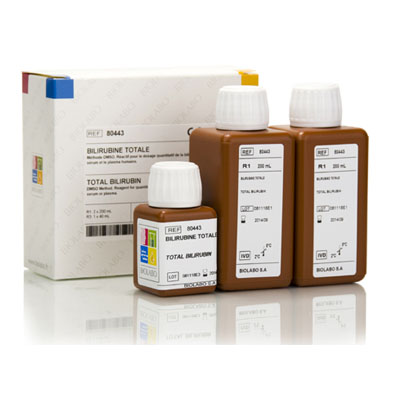
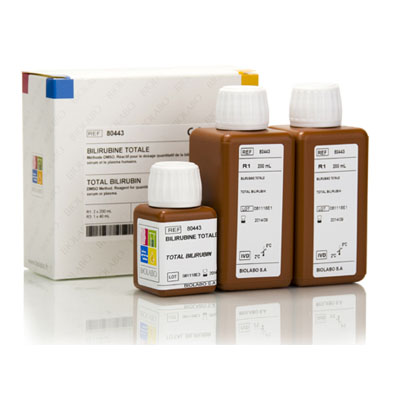
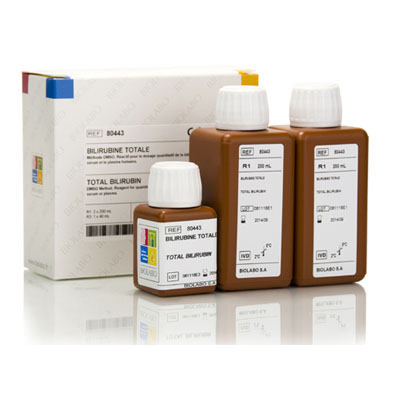
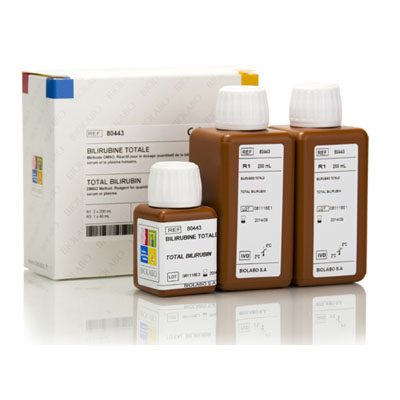
Cromatest (Urine And CSF) Protein Biochemistry Reagent
Packaging Size: 2x50 ml
Origin: Spain
Brand : Cromatest / Linear
Packaging Type: Bottle
Test/Pack: 100 Test
Method: colorimetric method

Standard Delivery
Delivery in 2-3 days
1 Year Warranty
Manufacturer warranty
Easy Returns
7 days return policy
Packaging Size: 2x50 ml
Origin: Spain
Brand : Cromatest / Linear
Packaging Type: Bottle
Test/Pack: 100 Test
Method: colorimetric method
The method1 measures the shift in the absorption spectrum from 460 to 600 nm of the complex that occurs at acid pH between pyrogallol red-multidate (PRM) and the basic amino groups of urine and cerebrospinal fluid (CSF) proteins. The intensity of the colored complex formed is proportional to the concentration of protein in the sample.
REFERENCE VALUES3
Urine
Adults:
24-h samples : < 150 mg/ 24-h single samples: < 25 mg/dL
CSF:
Adults: < 45 mg/dL
Child:< 100 mg/dL
It is recommended that each laboratory establishes its own reference range

Pyrogallol reagent:
. Succinate buffer 60 mmol/L pH 2.5, pyrogallol red 0.06 mmol/L, sodium molibdate 0.04 mmol/L, SDS 0.08 mmol/L. Xn. R20/22 S:24/25.
Urine protein standard: Albumin/Globulin 200 mg/dL (2 g/L). Buffered mixture (80/20) on an artificial matrix. Biocides
Store R1 at 15-30ºC, and CAL at 2-8ºC once opened.
The reagents are stable until the expiry date stated on the label.
REAGENT PREPARATION
The reagents are ready-to-use.
SAMPLES
Urine collected without preservatives, and CSF (see Notes). Turbid specimens should be centrifuged before testing.
Urine proteins are stable up to 8 days at 2-8ºC, and for 3 months at –20ºC. CSF proteins are stable for 3 days at 2-8ºC and for 3 months at –20ºC
The use of a standard to calculate results allows to obtain an accuracy independent of the system or instrument used.
To ensure adequate quality control (QC), each run should include a set of urine controls (normal and abnormal) with assayed values handled as unknowns.
CLINICAL SIGNIFICANCE
Total protein in the urine measurement is increasingly being replaced by the measurement of albumin, as this is the predominant urinary protein as this have demonstrated improved sensitivity and specificity for glomerular permeability changes.
The presence of increased urinary excretion signals an increase in the transpupillary escape rate, being usually a marker of microvascular disease even though it may be also altered by physiological factors (exercise, diuresis and posture) as a consequence of altered intrarenal hemodynamics.
The tubular reabsortive process is saturable and any increase in the glomerular permeability or in plasma concentration (e.g., of Bence-Jones protein), or decreases in reabsortive capacity due to proximal tubular damage (e.g., from nephrotoxic drugs) can result in proteinuria.
Persistent urinary albumin excretion precedes and is highly predictive of diabetic nephropathy, end-stage renal disease, and proliferative retinopathy in type I diabetes.5
Measurement of CSF protein is used to distinguish septic from aseptic meningitis. Protein concentrations > 1 g/L are often viewed as diagnostic for bacterial, fungal, or tuberculous meningitis.6
ANALYTICAL PERFORMANCE
| mg/dL | Within-run | Between-run | ||
| Mean | 64 | 180 | 65 | 175 |
| SD | 4.2 | 9.7 | 4.7 | 9.8 |
| CV% | 6.5 | 5.4 | 7.2 | 5.6 |
| N | 5 | 5 | 3 | 3 |
Replicates: 5 for each level. Replicates: 3 for each level Instrument: CECIL CE 2021 for 4 days.
N = 30 r = 0.996 y = 1.194 – 3.76
concentrations by » 10 mg/L for every 1000 erithrocytes.3

|
TUBES |
Blank |
Sample |
Standard |
| Reagent | 1.0 mL | 1.0 mL | 1.0 mL |
| Sample Standard | –
– |
20 mL
– |
–
20 mL |
Samples with concentrations higher than 400 mg/dL should be diluted 1:2 with saline and assayed again. Multiply the results by 2.
REFERENCES