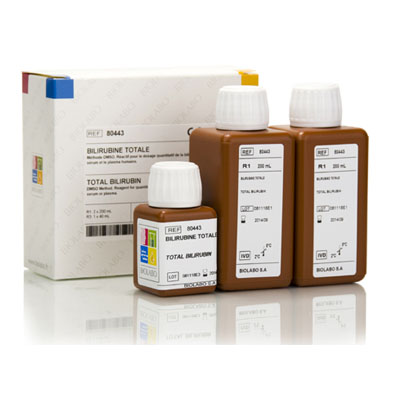
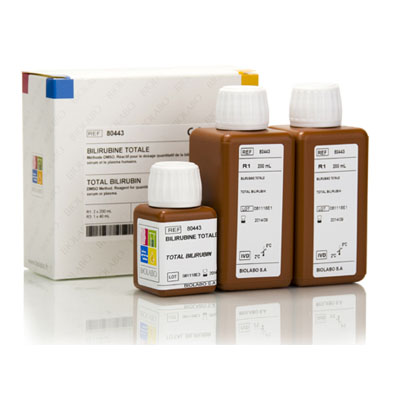
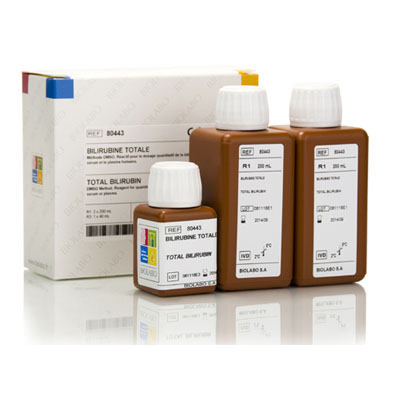
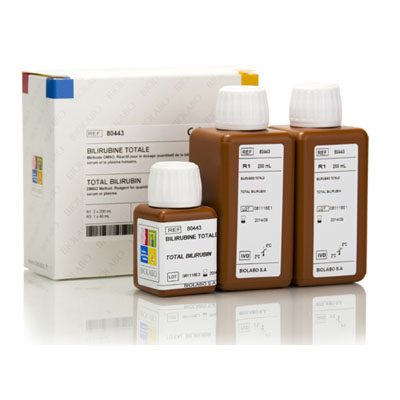
Cromatest Uric Acid Bio Chemistry Reagent
Packaging Size: 2x50 ml
Origin: Spain
Brand : Cromatest / Linear
Packaging Type: Bottle
Test/Pack: 100 Test
Method: Enzymetic colorimetric method

Standard Delivery
Delivery in 2-3 days
1 Year Warranty
Manufacturer warranty
Easy Returns
7 days return policy
Packaging Size: 2x50 ml
Origin: Spain
Brand : Cromatest / Linear
Packaging Type: Bottle
Test/Pack: 100 Test
Method: Enzymetic colorimetric method
Uric acid is oxidized by uricase to allantoin with the formation of hydrogen peroxide. In the presence of peroxidase (POD), a mixture of ADPS* and 4-aminoantipyrine (4-AA) is oxidized by hydrogen peroxide to form a quinoneimine dye proportional to the concentration of uric acid in the sample.1,2
REFERENCE VALUES3
Serum ,Plasma:
| Men | 3.5-7.2 mg/dL (208-428 mmol/L) |
| Women | 2.6-6.0 mg/dL (155-357 mmol/L) |
It is recommended that each laboratory establishes its own reference range

The Monoreagent and Standard are ready-to-use.
Store at 2-8ºC.
The Monoreagent and Standard are stable until the expiry date stated on the label.
Discard the reagent if presents an absorbance over 0.300 at 550 nm against distilled water or if it fails to recover the declared values of control sera.
Whenever possible medication should be suspended 12 hours before sample collection.
Hemolysis-free serum, EDTA or heparinized plasma, and urine (see Notes).
Uric acid in serum or plasma is stable up to 5 days at 2-8ºC and for 6 months at –20ºC.
Serum, plasma
Adults 37ºC up to 40 U/L (0.67 mkat/L
30ºC up to 25 U/L (0.42 mkat/L
Levels approximately twice the adult level are seen in neonates and infants; these decline to adult level by approximately 6 months of age.
It is recommended that each laboratory establishes its own reference range.
The use of a standard to calculate results allows to obtain an accuracy independent of the system or instrument used.
To ensure adequate quality control (QC), each run should include a set of controls (normal and abnormal) with assayed values handled as unknowns.
CLINICAL SIGNIFICANCE
Uric acid is the major product of the catabolism of purine nucleosides (adenosine and guanosine) from the purine metabolism pathway. Purines may be synthesized endogenously from the breakdown of nucleic acids or may be obtained from sources as diets in which nucleic acids are present.
An abnormal increase in the level of uric acid in the circulation above 7.0 mg/dL (0.42 mmol/L) is referred to as hyperuricemia
being the gout the major form of the ailment resulting in the deposition of urates in the soft tissues, especially in the joint areas. Increased levels may be also found associated with leukemia, toxemia of pregnancy and severe renal impairment.
Less common are the cases of hypouricemia where the concentration of uric acid is below 2.0 mg/dL (0.12 mmol/L). These cases are usually secondary to cases of hepatocellular disease, renal reabsorption defect, or overtreatment with uricosuric drugs used in the treatment of hyperuricemia.
brought to pH > 8 with 0.01N NaOH. Dilute urine 1:100 with distilled water before the analysis.
ANALYTICAL PERFORMANCE
Linearity: Up to 500 U/L
Precision
| mg/dL | Within-run | Between-run | ||||
| Mean | 4.8 | 8.4 | 13.7 | 4.8 | 8.3 | 13.6 |
| SD | 0.04 | 0.08 | 0.7 | 0.05 | 0.07 | 0.14 |
| CV% | 0.9 | 0.1 | 0.6 | 1.0 | 0.8 | 1.0 |
| N | 10 | 10 | 10 | 10 | 10 | 10 |
Replicates: 10 for each level. Replicates: 10 for each level Instrument: CECIL CE 2021 for 10 days.
N = 30 r = 0.995 y = 0.980 – 0.135
volume of sample with isotonic saline in the place of the reagent.
buscapine or high dosis of ascorbic acid (Vitamin C), compete with peroxidase for the hydrogen peroxide giving low results.
|
TUBES |
Blank |
Sample |
Standard |
| Monoreagent | 1.0 mL | 1.0 mL | 1.0 mL |
| Sample | – | 25 mL | – |
| Standard | – | – | 25 mL |
3.Mix and let stand the tubes 10 minutes at room temperature or 5 minutes at 37ºC.
The color is stable for at least 30 minutes protected from light
Samples with concentrations higher than 20 mg/dL should be diluted 1:5 with saline and assayed again. Multiply the results by 5.
If results are to be expressed as SI units apply: mg/dL x 59.5 = mmol/L
W.B. Saunders Co. Philadelphia, PA. (1995).
Fossati, P., Prencipe, L. and Berti, Q. Clin. Chem. 26 : 227 (1980